
You can generally chip clean tree branches, woody pruning waste, brush, and logs that fall within your wood chipper’s approved specifications. However, leaves, bamboo, palm fronds, and timber offcuts require closer attention because compatibility varies between machines.
The important question is whether your particular chipper is designed for the material you have. A branch that fits inside the hopper may still be unsuitable because of its shape, condition, or hidden contamination.
Therefore, before processing a pile of garden or forestry waste, check both the material and the machine’s operating instructions.
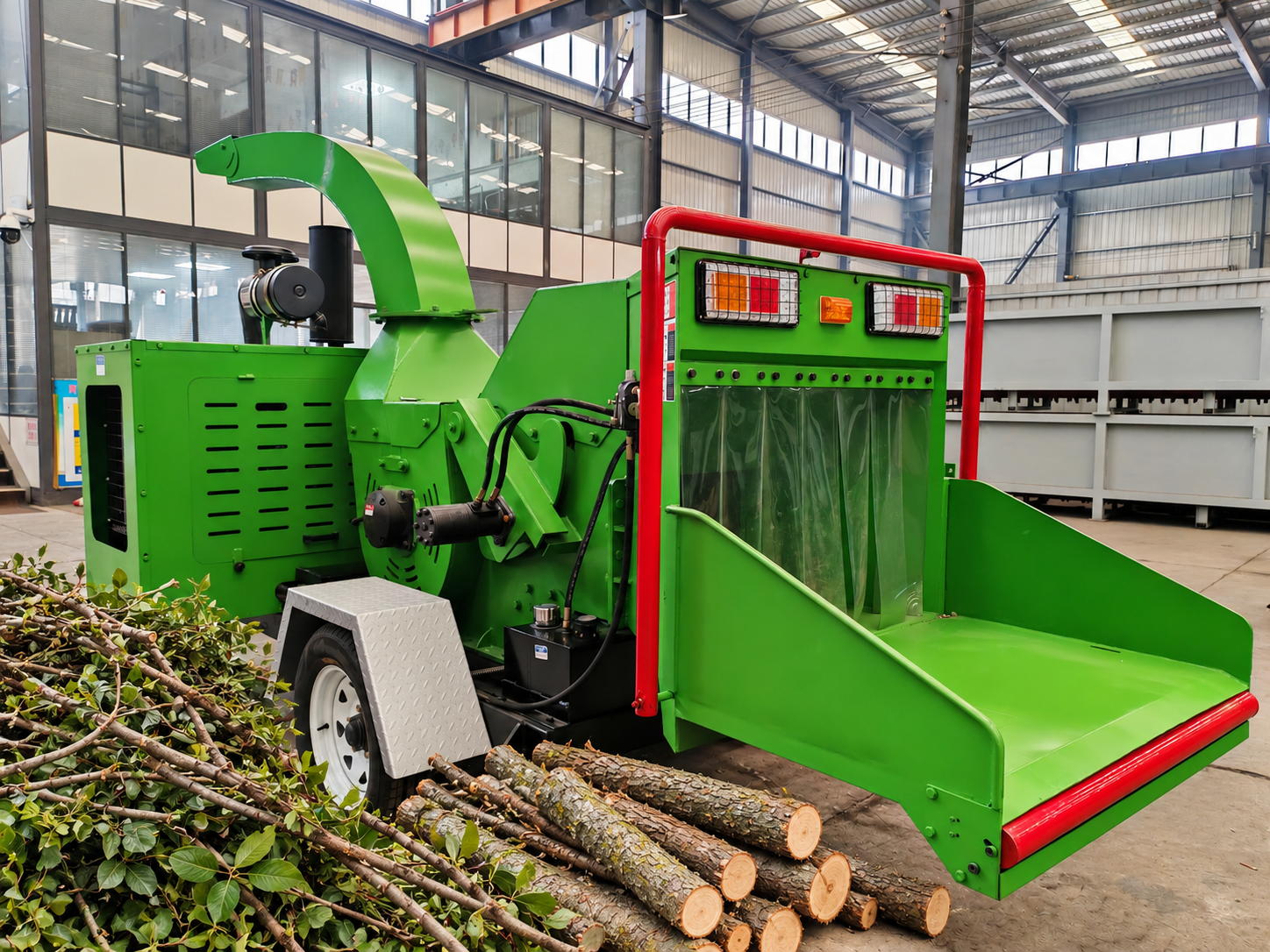
What Materials Can You Chip in a Wood Chipper?
The table below provides a starting point for sorting your material. However, it does not replace the approved material list in your operator’s manual.
| Material | General suitability | What to check |
|---|---|---|
| Tree branches and limbs | Usually suitable | Diameter, shape, condition, and contamination |
| Woody shrub and hedge cuttings | Usually suitable | Whether the load contains substantial woody stems |
| Logs | Suitable for appropriately rated machines | Approved dimensions and feeding requirements |
| Branches with attached leaves | Often suitable | The machine’s ability to process leafy material |
| Loose leaves and grass clippings | Usually better suited to shredding or composting | Whether a dedicated shredding function is available |
| Bamboo and palm fronds | Depends on the machine | Explicit manufacturer approval |
| Untreated timber offcuts | Conditional | Manufacturer approval, dimensions, and hidden fasteners |
| Painted, treated, or contaminated wood | Exclude from ordinary garden chipping | Material composition and an appropriate waste route |
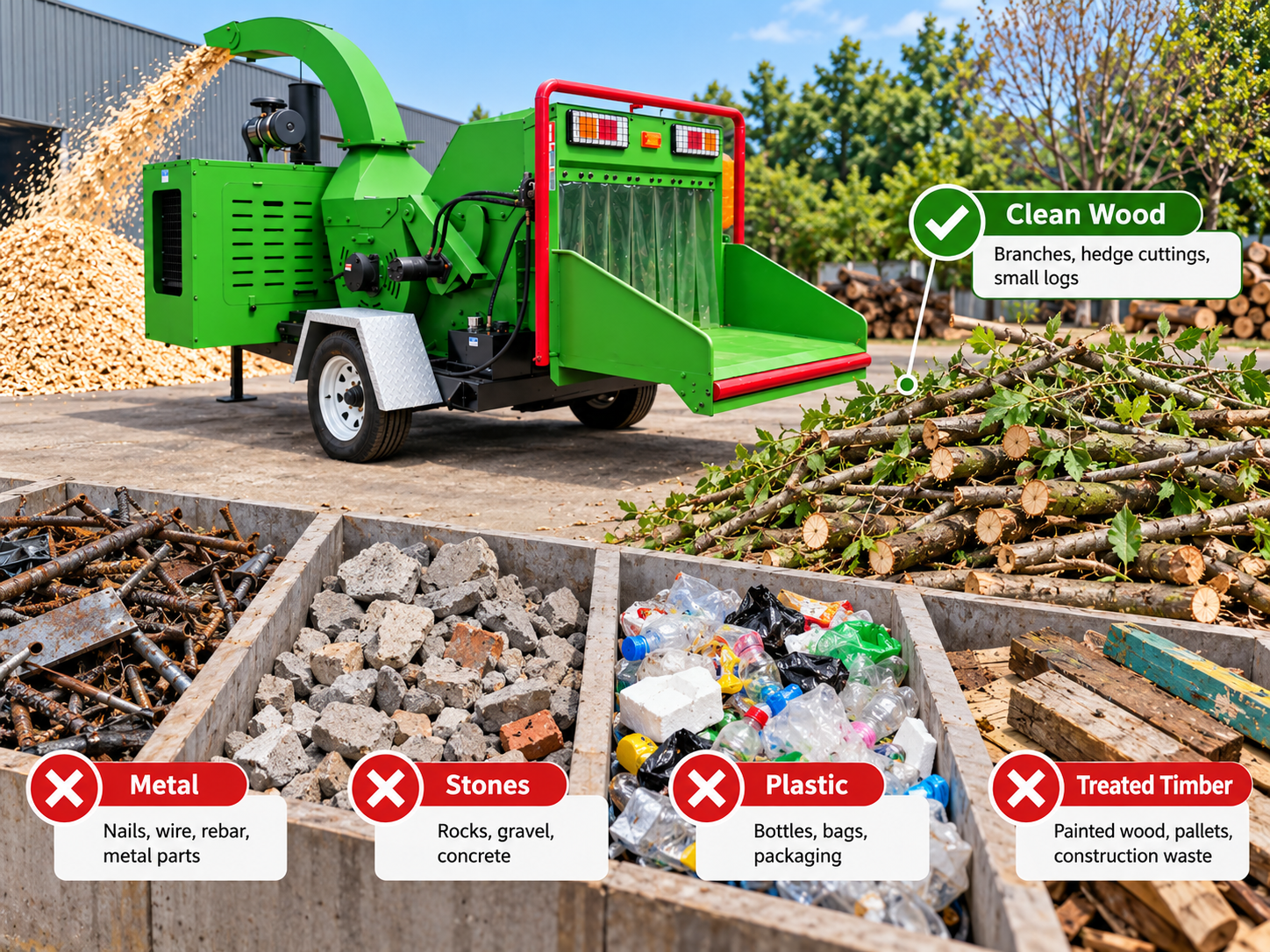
| Stones, metal, glass, and plastic | Unsuitable | Remove them before processing |
Manufacturers distinguish between these materials differently. For example, Hansa lists bamboo and palm fronds among suitable inputs for its equipment, while DR’s guidance distinguishes branch chipping from the shredding of lighter garden debris. Consequently, advice for one machine should not automatically be applied to another.
Which Woody Materials Are Normally Suitable?
Tree Branches and Pruned Limbs
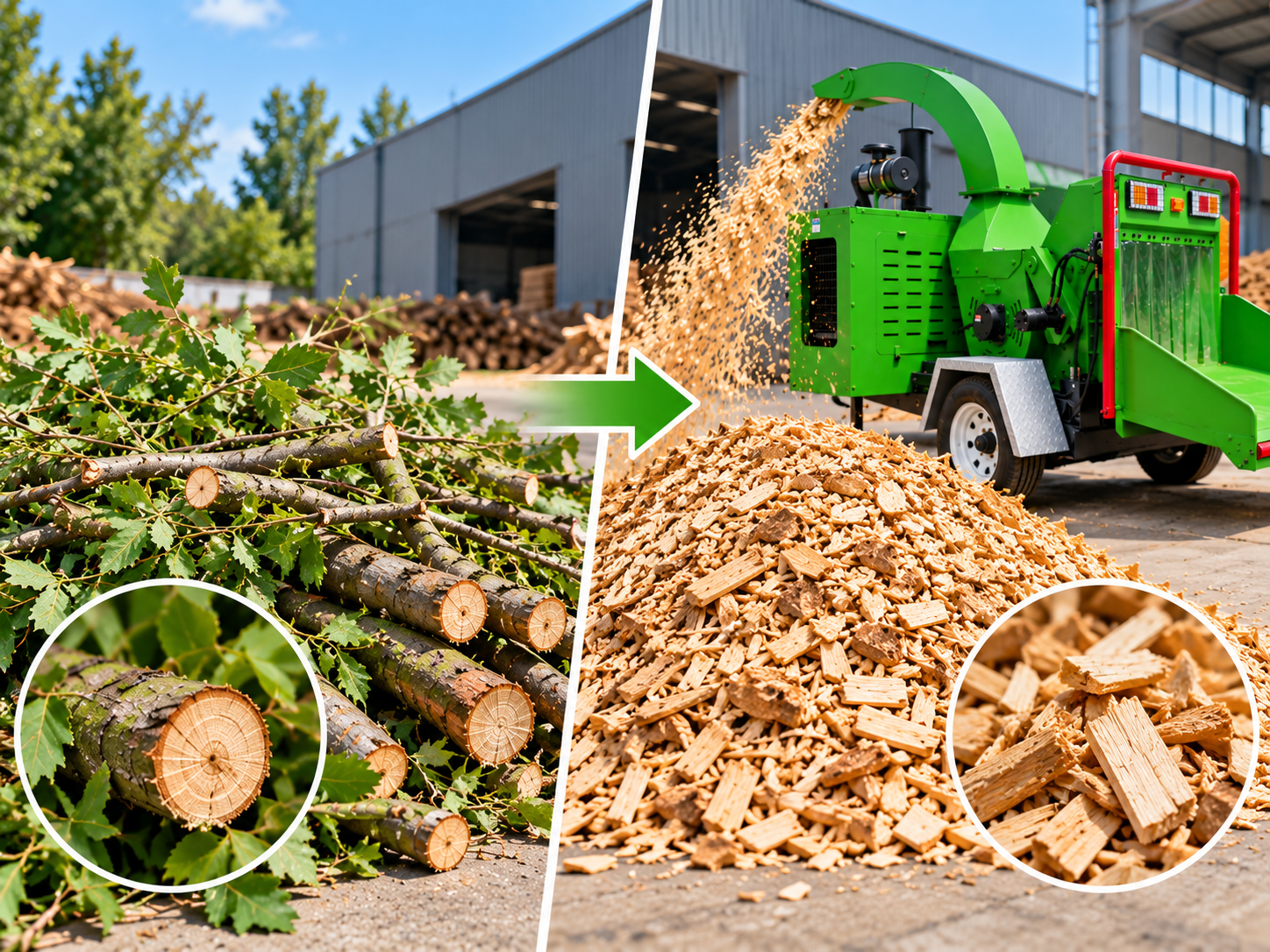
Branches from tree maintenance are among the most common materials processed by wood chippers. They provide the woody structure that a branch chipper is designed to cut.
However, their overall shape matters as well as their diameter. A forked limb or tangled bundle may present a different feeding challenge from a straight branch of the same thickness.
For this reason, assess the whole piece before processing it. Follow the manufacturer’s preparation and feeding instructions rather than forcing awkward material through the opening.
Woody Brush and Hedge Cuttings
Shrub stems, small saplings, and woody hedge cuttings can also be suitable.
However, “hedge cuttings” can describe two very different loads: substantial stems from reducing an overgrown hedge, or mostly soft foliage from light trimming. The first is closer to a wood chipper’s usual task; the second may call for a shredder.
Therefore, choose equipment according to the material that makes up most of the pile. Farmry’s PTO chipper guidance identifies branches, brush, pruning waste, and appropriately sized logs as typical inputs.
Fresh Wood and Dry Branches
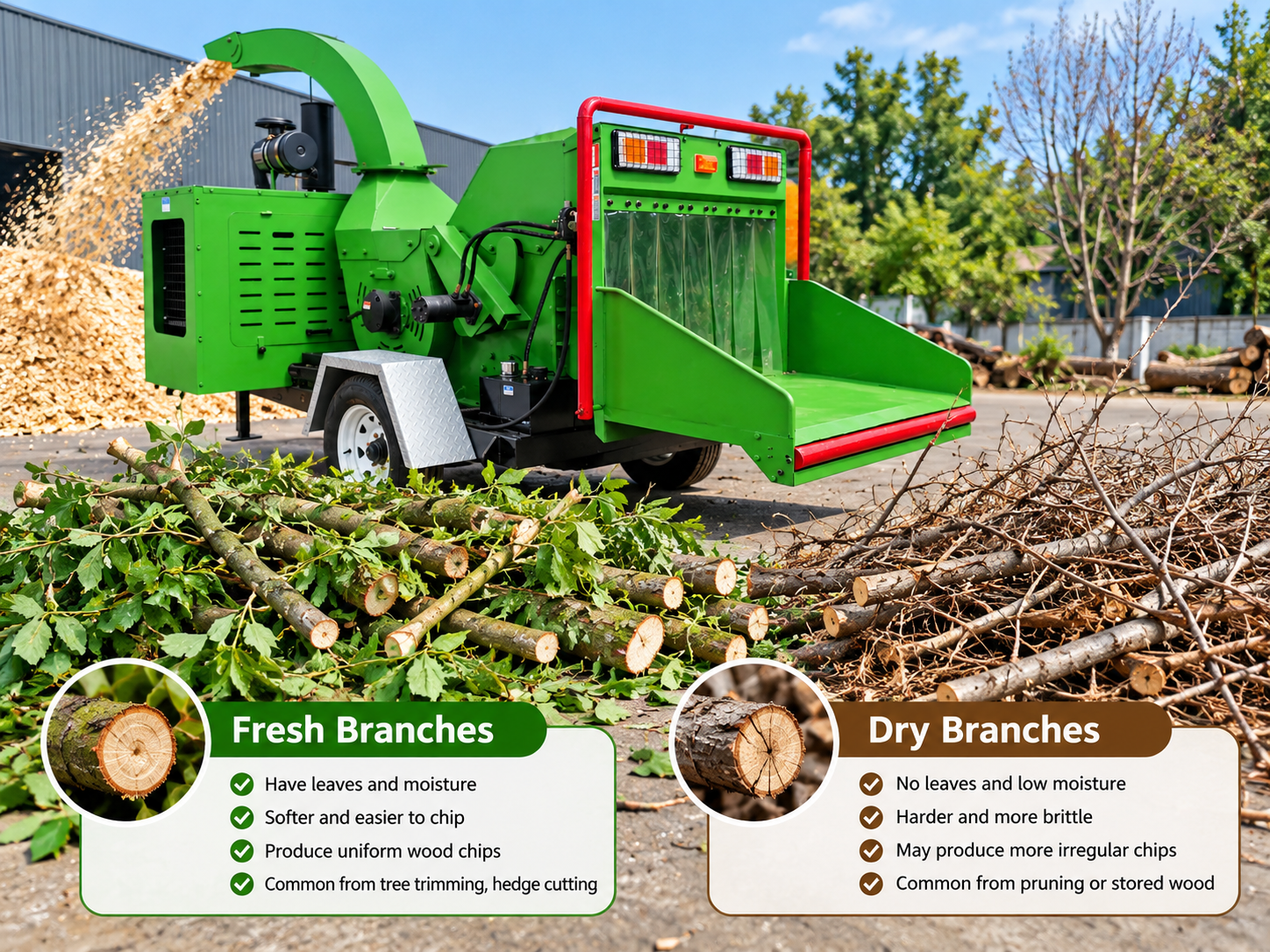
Freshly cut wood and dry wood can both be processable, depending on the model. Nevertheless, they should not be assumed to behave identically.
For example, BWM’s CP20 manual recommends freshly pruned branches and warns that dry wood can increase blade wear. Meanwhile, DR states that its chippers can handle fresh or dead wood within the specified dimensions.
As a result, moisture condition should be part of your equipment assessment. Avoid universal claims that dry wood is always easier—or that every chipper requires green wood.
Can You Chip Leaves, Grass, Bamboo, and Palm Fronds?
Branches with Leaves Versus Loose Leaves
Leaves attached to branches are different from a hopper full of loose foliage.
Some machines can process leafy branches effectively. For example, Ohashi describes equipment that processes both wood and leafy branches. However, that capability should not be interpreted as approval for every type of soft garden waste.
If most of your material consists of loose leaves, check whether the equipment has a suitable shredding system. In addition, use the correct inlet where a combined chipper-shredder has separate feeding routes.
Grass Clippings and Soft Garden Waste
Grass clippings, flowers, and other soft debris are generally a different processing task from cutting branches into chips.
Accordingly, a dedicated shredder or another suitable garden-waste method may be more appropriate. DR specifically directs lighter materials toward the shredding function of its combined machines.
Do not assume that a larger engine or wider hopper changes what the cutting system is designed to process.
Bamboo and Palm Fronds
Some wood chippers are designed to handle bamboo and palm fronds. However, these materials should be treated as model-specific inputs rather than universally suitable feedstock.
Before processing them, obtain confirmation for your exact machine and follow its material preparation requirements. Furthermore, describe whether your waste consists of bamboo poles, leafy tops, palm fronds, or a mixed load.
That distinction helps the supplier assess the actual task instead of answering a general question about “garden waste.”
Vines and Long, Stringy Plants
Vines and other long, flexible vegetation also require a separate assessment.
Some machines accommodate particular fibrous materials; others exclude them. Therefore, do not use successful processing of ordinary branches as evidence that tangled vines are suitable.
If the operator’s manual does not address the material, ask the manufacturer before introducing it into the feed system.
Can You Put Timber Offcuts or Pallets in a Wood Chipper?
Clean Timber Offcuts
Timber offcuts require more than a quick visual check.
First, establish whether the wood is untreated, unpainted, and free from adhesives or contamination. Next, check for nails, screws, staples, brackets, and other hidden objects.
Even then, clean timber should only be processed if the manufacturer approves its dimensions and form. Permission to chip natural branches does not automatically extend to every board, block, or short offcut.
Wooden Pallets
Pallets deserve particular caution because their condition and construction may be uncertain.
For example, Timberwolf advises against chipping old pallets and highlights the need to remove nails and metal components. Removing visible nails alone does not establish that a pallet is suitable.
Consequently, businesses handling pallet waste should seek equipment specifically approved for that feedstock, rather than assuming an ordinary branch chipper will do the job.
What Should You Keep Out of a Wood Chipper?
Stones, Soil, Metal, and Other Foreign Objects
Inspect wood for contamination before it reaches the machine.
Stones, soil, sand, wire, metal fittings, glass, and plastic do not belong in an ordinary wood-chipping load. These materials can damage cutting components or introduce other hazards.
Storm debris, fencing waste, and material collected from the ground deserve extra attention. However, a larger machine does not remove the need to sort the load. Hansa’s manufacturer guidance specifically warns that foreign objects can damage the blades and potentially the machine.
Treated, Painted, or Chemically Contaminated Wood
Keep pressure-treated timber, painted boards, and chemically contaminated wood out of ordinary garden-chip production.
Chipping changes the size of the material; it does not establish that the resulting chips are suitable for landscaping or other reuse. The US EPA notes that wood-preservative treatments and treated products can present risks to people and the environment.
Therefore, separate uncertain material and use an appropriate waste-management route.
Oversized or Unapproved Material
Finally, exclude material outside the machine’s approved limits.
Do not treat the hopper opening as proof of processing capacity. Instead, use the specifications and operating instructions for the exact model.
For a practical model reference, review the TIROX 12-inch wood chipper specifications, then confirm the approved material dimensions for your selected configuration.
How Do You Decide Whether Your Material Is Suitable?
Start with the Operator’s Manual
First, check the approved materials, maximum dimensions, feeding requirements, and restrictions for your model.
If an unusual material is not covered, contact the manufacturer. A useful enquiry includes photographs, typical dimensions, moisture condition, and any possible contamination.
For TIROX equipment, ask our team to confirm material compatibility for your exact model and configuration.
Follow the Required Operating Procedure
Material selection is only one part of safe chipping.
Keep hands and feet out of the infeed area, maintain the required operating position, and use the protective equipment specified for the task. Additionally, never reach into the machine to investigate a blockage.
Before clearing or servicing it, follow the prescribed shutdown and energy-isolation procedure, and wait for moving parts to stop. These precautions reflect OSHA’s guidance on wood-chipper hazards.
Match the Input to the Intended Output
Next, explain what you want to produce.
Reducing pruning waste for easier handling is different from supplying chips to a customer with defined requirements. Therefore, an equipment enquiry should describe both the incoming material and the intended use of the chips.
For example, provide this information:
- Material type and typical dimensions.
- Fresh, dry, leafy, or mixed condition.
- Expected contamination.
- Quantity to process.
- Intended use of the output.
Together, these details provide a clearer basis for machine selection than branch diameter alone.
Frequently Asked Questions
Can You Chip Branches with Leaves on Them?
Often, yes, where the manufacturer approves leafy branches. However, attached foliage and a load of loose leaves are different inputs, so check the machine’s instructions.
Can a Wood Chipper Process Any Wood That Fits?
No. Suitability also depends on the approved dimensions, wood condition, contamination, and feeding method. The opening alone does not establish compatibility.
Can You Put Roots or Stumps in a Wood Chipper?
Do not assume they are suitable. Roots and stumps require explicit equipment approval, and soil or embedded stones must be considered. Ask the supplier about the actual material before choosing a processing method.
Does a More Powerful Chipper Accept More Types of Waste?
Not automatically. Additional power does not override material restrictions or turn a branch chipper into a general waste processor. Always check the approved application of the complete machine.